
Plan the table before you open the doors, and avoid costly tableware mistakes later.
Opening a new restaurant or hotel is a series of hundreds of little decisions. One of them is tableware. But it may easily become a big purchase. A precise restaurant opening checklist helps buyers decide what to buy, how many pieces are needed, and which products fit the menu. Planning early also means no last-minute purchases, no mismatched designs, and no wasteful expenditure.
Tableware should be suited to the sort of cuisine, service, and dining experience you are planning.
Some simple dishes, bowls, glasses, and silverware can be needed for a casual restaurant. A fine dining room could need distinct forms and finishes and various serving items. Hotels may need to make separate collections for restaurants, breakfast sections, banquets, room service, and events.
Note what meal services are scheduled and the goods that will be needed for each one before ordering.
Buying too few might cause issues during busy service. Overbuying can lead to wasted money and storage space.
Begin with the projected number of seats and the daily volume of guests. Then think about how many times over a service period each table setup may be used.
A restaurant with 100 seats, for example, could need more than 100 plates, as some will be in the kitchen, being washed or held for the following service.
A simple computation should include:
Do not treat tableware as one large purchase. Divide the requirement into categories.
A common list looks like this:
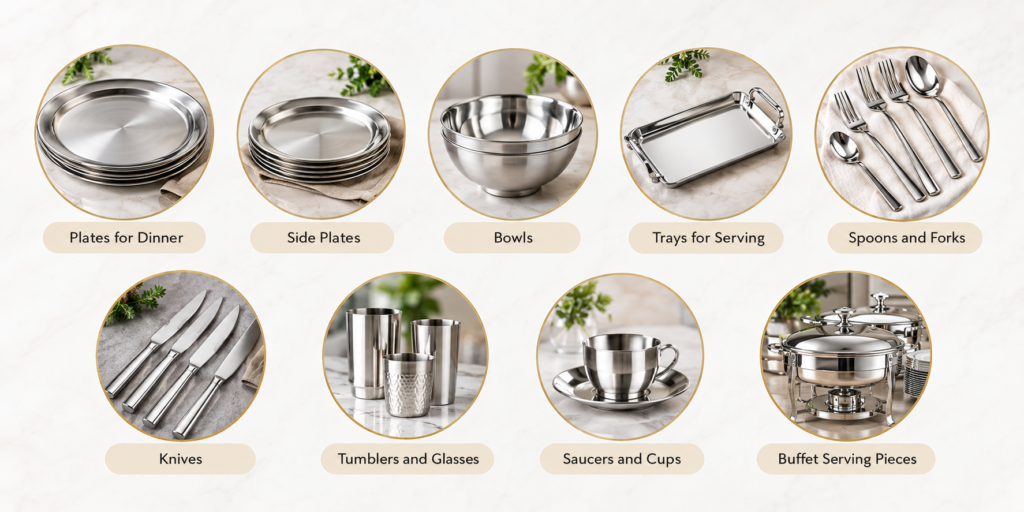
This makes it easy to shop and helps you know if you are missing anything before you open it.
The dinnerware should be an extension of the menu. A restaurant providing Indian food may require thalis, katoris, handis, and serving bowls. A steakhouse may need bigger plates and customized serving pieces. A hotel breakfast service may need bowls, plates, cups, trays, and buffet items.
Therefore, tableware should only be picked after the menu and the serving arrangement are fairly well defined.
Storage is typically an afterthought until the items arrive. Before ordering a large order, measure shelves, cabinets, racks, and service areas. If possible, select pieces that stack neatly. Also store commonly used goods near the service area. This saves the workers time in hectic times.
A startup must manage its beginning budget prudently. But buying things just because they are inexpensive might cost more in the long run.
Compare material quality, construction, finish, projected use, availability of replacement. Good planning might enable you to allocate your spending between needed items and ornamental things.
It’s a vital aspect of hotel procurement, especially when there are a number of eating places that require items at the same time.
A whole purchase strategy must include more than just the plates and utensils.
A good hospitality supplies checklist may include:
This longer list helps prevent small but crucial things from being overlooked before opening day.
Tableware should be uniform in appearance across the dining area. Choose finishes, shapes, and sizes that go well together. Hotels that have more than one restaurant may have different designs for each idea but a level of quality that is the same for each.
Not every product has to be the same, but the whole display must appear organized and professional.
Later, a new restaurant or hotel can add more seats, food, or event services. Therefore, find a provider who offers matching items when more quantities are needed.
Before you select the provider, ask about bulk orders, lead times, customization, finishes, and replacement items.
Check all quantities and product specifications before placing the final order.
Verify product names, sizes, finishes, packing, and delivery dates as necessary. Maintain a small reserve of regularly used pieces for unforeseen damage or increased visitor numbers.
This last evaluation is a crucial aspect of any restaurant opening checklist, as replacing missing items at the last minute before opening may be expensive and overwhelming.
New restaurants and hotels may plan their tableware needs before launching to reduce expenses and avoid last-minute complications. Such factors as menu, seating capacity, service style, storage space, budget, and future expansion should lead the purchase.
De’Stellar offers stainless steel dinnerware and hospitality items to restaurants, hotels, caterers, and institutional clients. Our goods include dinnerware, thali sets, platters, portion bowls, buffet displayware, barware, and other tableware products in finishes such as mirror, matte, embossed, hand-hammered, gold PVD, rose gold PVD, and gunmetal.
Let us help you plan the ideal assortment of dinnerware for your new restaurant or hotel. Contact us now to discuss your numbers, product demands, finishes, and bulk purchase requirements.
The quantity will depend on the seating capacity, number of guests, meal services, washing time, and the extra stock needed for replacement.
Dinnerware, cutlery, glasses, serving pieces, buffetware, room-service items, and products for banquets and occasions should be planned by a hotel.
Tableware should be ordered far ahead of opening so that goods may be verified, kept, and replaced if necessary.